Check out our LIVE events!
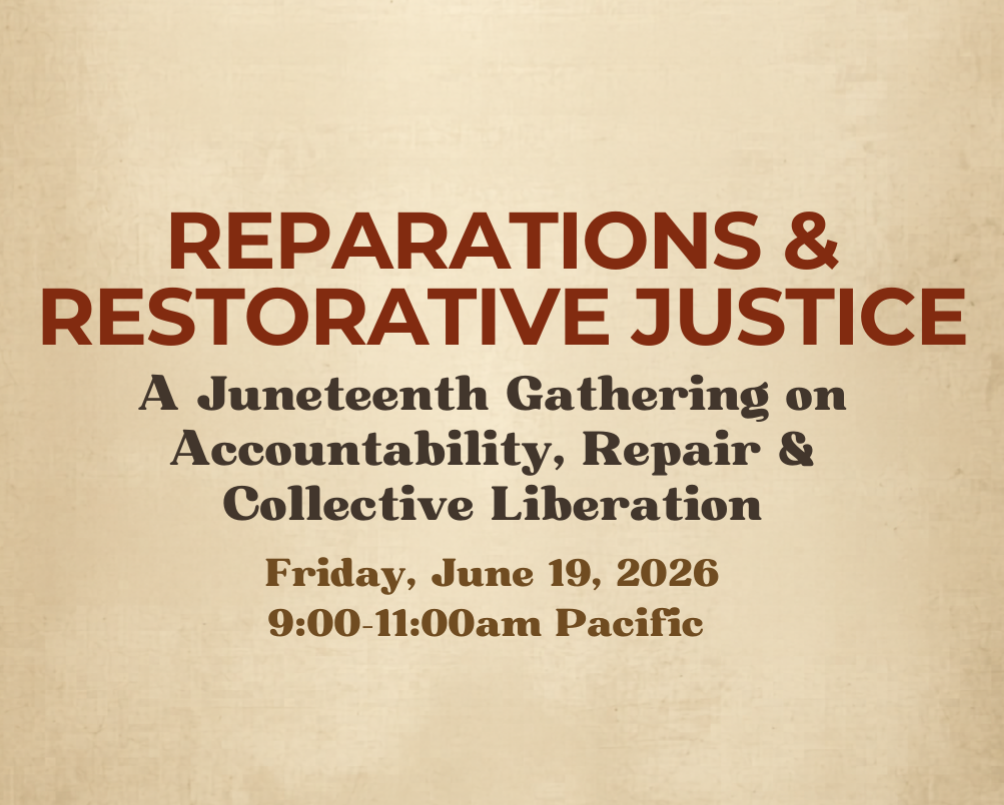
Reparations & Restorative Justice
A Juneteenth Gathering on Accountability, Repair & Collective Liberation
Contribute with reciprocity (sliding scale)
Juneteenth commemorates June 19, 1865, the day enslaved Black people in Texas finally learned they were legally free, more than two years after the Emancipation Proclamation.
Many Juneteenth events focus on celebration. Others focus on history.
This gathering focuses on reparations.
Not as a policy debate or thought experiment, but as a restorative question.
What do we owe one another when harm has occurred? What responsibilities remain when the people who caused the harm are gone but the impacts continue? What distinguishes acknowledgment from accountability, accountability from repair, and repair from reparations?
Through a restorative justice lens, we'll explore the legacies of chattel slavery, anti-Blackness, and white supremacy, not simply as historical realities, but as forces that continue to shape our relationships, institutions, communities, and daily lives.
Together we'll examine how restorative justice frameworks can help us think about inherited harm, collective responsibility, reparations, and the ongoing work of repair.
This is not a debate about whether racism exists.
This is not a workshop designed to induce guilt or shame.
It is an opportunity to explore what freedom, accountability, reparations, and solidarity might require of us today.
Why This Conversation?
When most people hear the word reparations, they think about money.
While financial compensation is one possible form of reparations, restorative justice invites a broader set of questions.
What happens when harm occurs and the impacts continue long after the original act?
What responsibilities remain when institutions, communities, and systems have benefited from that harm?
What distinguishes acknowledgment from accountability, accountability from repair, and repair from reparations?
Juneteenth offers an opportunity to explore those questions through one of the clearest examples of collective harm and delayed accountability in United States history.
The goal of this gathering is not to tell participants what to think about reparations.
The goal is to examine how restorative justice frameworks can help us understand historical harm, collective responsibility, and the work of making things as right as possible.
What We'll Explore
What restorative justice can teach us about historical and collective harm
The relationship between chattel slavery, anti-Blackness, and white supremacy culture
The difference between acknowledgment, apology, accountability, repair, and reparations
How harm continues to echo across generations, institutions, and communities
How anti-Blackness impacts Black communities, non-Black communities of color, and white communities differently
What meaningful solidarity and collective responsibility can look like in practice
Concrete next steps for engaging in restorative action beyond Juneteenth
Affinity Space Conversations
Following the teaching portion of the gathering, participants will have the opportunity to join an affinity space for deeper reflection and conversation.
While all participants will engage with the same core ideas, the histories we inherit, the harms we experience, and the responsibilities we hold are not identical. Affinity spaces create an opportunity to explore those differences in community with others who share similar identities and experiences.
Black Participants
A space for Black participants to reflect on freedom, memory, resilience, healing, joy, internalized anti-Blackness, and collective care.
Together we'll explore what repair, liberation, and community mean in the context of both historical and ongoing anti-Blackness.
Non-Black Participants of Color
A space to explore anti-Blackness as a function of white supremacy, the ways it shows up within our communities, proximity to whiteness, colorism, solidarity, and our role in collective liberation.
Together we'll examine what meaningful accountability and cross-racial solidarity can look like in practice.
White Participants
A space to explore accountability beyond guilt, inherited advantage, white supremacy culture, defensiveness, and meaningful participation in repair.
Together we'll consider what responsibility, solidarity, and restorative action can look like in our relationships, workplaces, institutions, and communities.
A Note for Mixed-Race & Multiracial Participants
If you are mixed race, multiracial, or hold multiple identities, you are welcome to join whichever affinity space feels most meaningful, supportive, or relevant to you.
There is no identity verification process and no expectation that you explain or justify your choice.
We trust participants to choose the space that best supports their learning, reflection, and participation.
Who This Gathering Is For?
This gathering is for people who believe Juneteenth should mean more than a social media post, corporate statement, or day off work.
It is for people who are curious about reparations but want a deeper conversation than a political debate.
It is for people who want to understand how historical harm continues to shape present-day relationships, institutions, and communities.
It is for educators, leaders, parents, organizers, facilitators, practitioners, students, community members, and anyone interested in exploring questions of accountability, repair, solidarity, and collective responsibility.
Whether you are new to Restorative Justice or have been practicing for years, you are welcome.
No prior experience with Restorative Justice is required.
What is required is a willingness to engage difficult questions with curiosity, humility, and care.
Facilitator
David Ryan Barcega Castro-Harris is a Black and Filipino Restorative Justice practitioner, educator, facilitator, coach, and founder of Amplify RJ.
For more than a decade, David has supported schools, organizations, leaders, teams, and communities in navigating conflict, strengthening relationships, building accountability, and creating healthier cultures. His work sits at the intersection of Restorative Justice, anti-racism, leadership development, communication, and organizational culture.
David believes that restorative justice offers more than a response to individual conflict. It provides a framework for understanding historical harm, collective responsibility, and the work of repair.
David will facilitate the teaching portion of the gathering alongside a team of Black facilitators who will lead the affinity space conversations.
Additional facilitator information will be shared as the event approaches.
Registration & Contribution
This gathering is offered on a contribution basis.
$40 is the suggested contribution. Forty acres and a mule was the reparations promise made and broken in 1865. Forty dollars is a start.
If $40 isn't accessible right now, contribute what you're able — including the platform minimum. No explanation needed, and Black participants are always welcome to register at any amount.
If you're able to go beyond $40, consider what that reflects: capacity, privilege, proximity to systems that have benefited from the harms we'll be discussing. Contributing more is one way to make this gathering more accessible to others, supports Amplify RJ in continuing to do this work, and one small, concrete act of repair in itself.
Registration Includes
Live participation in the gathering
Access to the teaching portion recording
Participation in an affinity space conversation
Reflection questions and follow-up resources
Connection to future Amplify RJ offerings and events
Freedom was delayed.
Repair remains unfinished.
Join us as we explore what restorative justice can teach us about the work still ahead.
Frequently Asked Questions
Will there be a recording?
The teaching portion of the gathering will be recorded and shared with registered participants.
Affinity spaces will not be recorded.
Many of the conversations that emerge in affinity spaces involve personal reflection, vulnerability, and community dialogue. To support honest participation and confidentiality, those portions of the event will remain off-camera and off-recording.
What if I'm mixed race or identify with more than one group?
You are welcome to join whichever affinity space feels most meaningful, supportive, or relevant to you.
There is no identity verification process and no expectation that you explain or justify your choice.
Many people hold multiple racial, ethnic, cultural, and social identities. We trust participants to choose the space that best supports their learning, reflection, and participation.
Why a contribution-based registration model?
The contribution model reflects several realities.
First, I want the gathering to remain accessible to people with different financial circumstances.
Second, I want facilitators to be compensated for their labor, preparation, experience, and care.
Third, Juneteenth invites us to reflect on the unequal distribution of wealth, opportunity, safety, and power that continues to shape our society. Rather than setting a single ticket price for everyone, participants are invited to contribute in a way that reflects their capacity, circumstances, and commitment to the work.
The suggested contribution is $40, but participants are welcome to contribute more or less.
Why are Black participants invited to register at any amount?
Juneteenth commemorates the end of chattel slavery and the ongoing struggle for freedom, dignity, and repair.
Because this gathering centers the legacy of anti-Black racism and its continuing impacts, Black participants are invited to register at any amount, including the platform minimum.
This is not a scholarship application and no explanation is required.
Will this be a debate about reparations?
No.
While questions of reparations may arise, the purpose of the gathering is not to debate whether harm occurred or whether repair is needed.
Instead, we'll use restorative justice frameworks to explore what accountability, repair, and collective responsibility can teach us about the world we inherited and the world we are helping create.
Do I need prior experience with Restorative Justice?
No.
Whether this is your first introduction to Restorative Justice or you've been practicing for years, the gathering is designed to be accessible, reflective, and practical.
Is this gathering facilitated by Black people?
The gathering will be led by David Ryan Barcega Castro-Harris, a Black and Filipino Restorative Justice practitioner, educator, facilitator, and founder of Amplify RJ, alongside additional Black facilitators.
Contribute with reciprocity ($119 suggested)